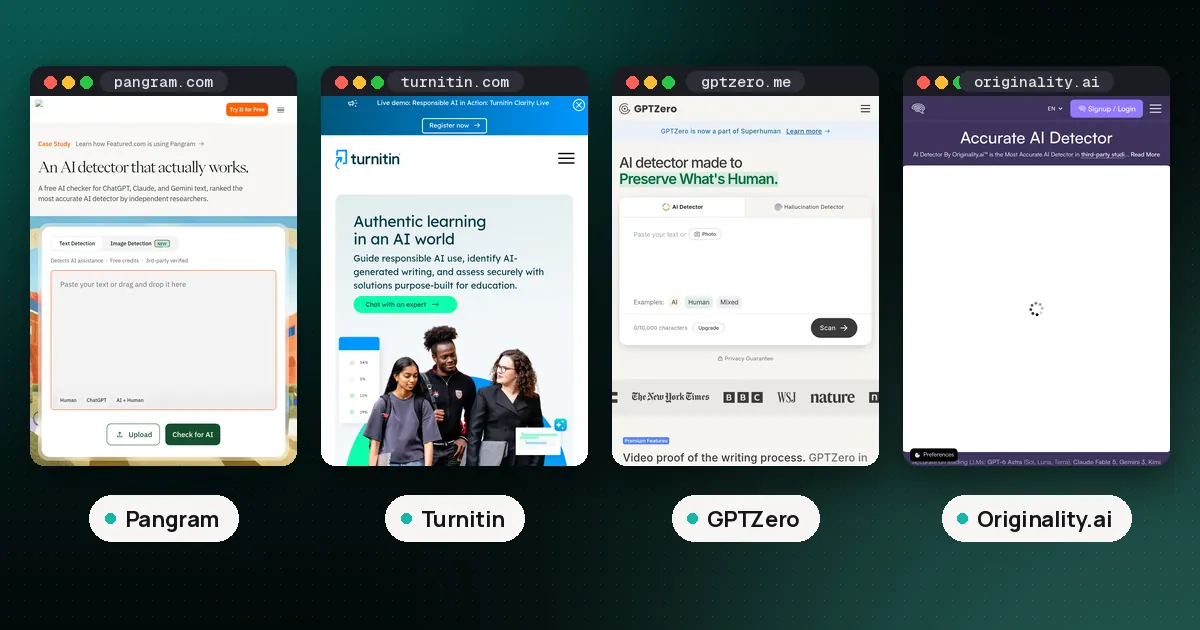
Pangram vs Turnitin is a choice between a freemium AI detector that also sells LMS integrations and an institutional integrity platform whose AI writing indicator only instructors can see. Pangram lets anyone run up to 2,000 words a day for free, ships Pangram 4.1 as its current model, and offers Canvas, Moodle, Brightspace, Blackboard, Schoology and Google Classroom on an Educational Institution plan. Turnitin has no consumer signup: AI writing lives inside the Similarity Report for schools that license Turnitin Originality (or iThenticate 2.0 with the AI addon), and students cannot open that score on their own.
Neither score should decide misconduct alone. A June 2026 peer reviewed study of 160 academic papers found Pangram far closer to ground truth on fully AI, hybrid and humanised text, while Turnitin, GPTZero and Copyleaks often underdetected advanced AI writing, and all four tools cleared fully human papers. Below is a practical breakdown of access, scoring rules, features and who each product actually fits.
Pangram vs Turnitin at a glance
| Item | Pangram | Turnitin |
|---|---|---|
| Who can buy or use it | Anyone: teachers, publishers, developers; schools via Educational Institution | Schools, universities and publishers via institutional license |
| Free path | Up to 2,000 words per day, no card (Pangram) | None for individuals |
| Paid individual | Individual about 20 dollars/month (15 billed annually); Professional about 65 dollars/month (pricing) | No public list price |
| Can students see the AI score? | Yes, if they run their own scan | No, unless an instructor shares the PDF |
| Current model / updates | Pangram 4.1 (released October 19, 2026; successor to Pangram 4 from July 29, 2026; model card back online October 25) | English architecture update October 2026; multilanguage AI writing |
| Score style | Document verdict plus section windows (AI / AI assisted / human) | Percentage of qualifying prose; 1 to 19% shown only as an asterisk |
| LMS workflow | Educational Institution: Canvas, Moodle, Brightspace, Blackboard, Schoology, Google Classroom | Built into Similarity Report in Canvas, Moodle, Blackboard and similar |
| Extra modalities | AI image scans on every plan; detection in 20 plus languages | Similarity corpus match + AI indicator; Clarity draft playback addon |
In plain terms: pick Pangram when you need a tool you can open today, or a school wants LMS native AI checks without giving up a freemium path for teachers. Pick Turnitin when your campus already licenses it for Similarity matching and you need an instructor only AI indicator in the existing workflow. For other freemium classroom options, see Pangram vs GPTZero and GPTZero vs Turnitin.
Who each tool is for
Pangram
Pangram is built for educators, publishers and trust and safety teams that want section level AI and AI assisted labels, not only a single percentage. The free plan covers up to 2,000 words per day with file upload, OCR, Chrome and Google Docs integrations, detection in over 20 languages, and a few image scans per day (Pangram homepage). Individual is listed at about 20 dollars a month (about 15 billed annually) for up to 300,000 words and 100 image scans; Professional is about 65 dollars a month (about 45 billed annually) for up to 1.5 million words, 500 image scans and 200 dollars of monthly API usage (pricing).
The Educational Institution plan is the LMS path: contact sales for pricing, unlimited AI and plagiarism checks inside the LMS, usage analytics, and a stated policy that Pangram does not train on student data. Supported LMS integrations include Google Classroom, Canvas, Schoology, Moodle, Blackboard and Brightspace (LMS FAQ, last reviewed July 24, 2026). That puts Pangram closer to Turnitin’s LMS model while keeping a freemium path Turnitin does not offer.
Writers on Substack can also use Pangram through Substack’s Scan for AI text feature; see how to use Pangram on Substack.
Turnitin
Turnitin is built for institutional workflows. AI writing detection is available only to customers who license Turnitin Originality, or iThenticate 2.0 with the AI writing addon. An administrator can disable the feature for the whole account. The AI indicator sits inside the Similarity Report, so it appears wherever Canvas, Moodle, Blackboard or another LMS already opens Turnitin reports. Students do not see the AI percentage unless an instructor downloads the PDF and shares it (Turnitin AI writing FAQ, updated October 14, 2026).
There is no consumer signup and no public price list. Similarity matching against Turnitin’s academic corpus remains its historic strength; the AI indicator is an overlay on that report, not a plagiarism replacement. For publisher focused self serve detection, also compare Originality.ai vs Turnitin.
How the scores differ
Turnitin’s AI writing indicator
Turnitin scores sentences in context, labels sentences above a threshold as AI, and reports the share of qualifying prose, not of the whole file. Lists, headers, references, tables and code are omitted. English submissions need at least 300 words of long form prose and no more than 30,000 words. Scores from 1 to 19 percent appear only as an asterisk with no highlights, a deliberate false positive brake. Turnitin states it aims to keep the document level false positive rate under 1 percent for documents with more than 20 percent AI writing, and that the percentage must not be the sole basis for disciplinary action (FAQ).
As of October 2026 the FAQ lists a long roster of frontier chat models for English detection and notes an October 2026 architecture update aimed at better accuracy at human and AI transition points. Supported AI writing languages include English, Spanish, Japanese, Arabic, Dutch, German and Turkish; AI paraphraser / “humanizer” detection remains English only. Similarity score and AI percentage are independent.
Pangram’s section windows and Pangram 4
Pangram returns a document level verdict plus section windows with AI, AI assisted and human fractions. That granularity helps when a paragraph was lightly edited or co-written. Pangram announced Pangram 4 on July 29, 2026: the company says the model is roughly six times larger than Pangram 3, improves mixed authorship and humanizer detection, and reports a vendor false positive rate of 0.0041 percent (about one in 24,000 documents) and a false negative rate of 0.3396 percent on its challenge sets (Introducing Pangram 4). Pangram 3 was scheduled for deprecation on September 30, 2026. Treat vendor benches as self reported until independents retest the shipping model. Pangram released Pangram 4.1 on October 19, 2026 as the successor to Pangram 4. Its model card reports more stable predictions under small edits (unintended verdict flips across 29,103 paired edits fell from 1.08 percent to 0.15 percent) and adds a class probabilities output showing how sure the model is of each label (Pangram 4.1 model card). The card was offline on October 24 and is back as of October 25 with the same figures. Pangram also says its dashboard now shows less certainty for text under 150 words.
What independent studies show
Two public 2026 sources are more useful than vendor win blogs for this pairing.
Van Vlasselaer, Van Droogenbroeck and Spruyt (International Journal for Educational Integrity, June 29, 2026). Researchers tested GPTZero, Pangram, Copyleaks and Turnitin on 160 academic papers with known authorship: fully human (pre ChatGPT graduate work), fully AI (ChatGPT Deep Research mode, May 2025), hybrid (human papers with AI replaced sections) and humanised GenAI (open access article). All four tools correctly cleared fully human papers. On fully AI papers, Pangram’s strict accuracy was 65 percent (inclusive 97.5 percent), while Turnitin classified 100 percent of those papers as false negatives (scores in the 0 to 20 percent band). On hybrid and humanised sets, Pangram’s strict accuracy was 92.5 percent; Turnitin reached about 60 percent on hybrid and 50 percent on humanised. The authors conclude detection tools can flag cases for review but should not be sole evidence in high stakes decisions. AI samples predate Pangram 4 and Turnitin’s later 2026 model updates.
Epoch AI data insight (July 15, 2026). On 495 pre ChatGPT human passages and 594 AI passages from Claude Opus 4.8, GPT-5.5 and Gemini 3.1 Pro, Pangram 3.3.2 posted a 0 percent false positive rate on human text. On plainly prompted AI, misses were near zero; on style imitated AI, Pangram missed about 10 percent (Epoch AI). Turnitin was not in that three detector bench; the useful takeaway for Pangram is low false positive risk on clean human prose and remaining miss risk on author style imitation, especially scientific writing.
For a wider tour of detector reliability, including GPTZero 4o and Originality.ai caveats, see Are AI detectors accurate?.
Features that change day to day use
Access and who sees the score. Pangram is something a teacher, freelancer or student can open tonight. Turnitin’s AI indicator is instructor only by design. That single difference decides most real world “vs” searches for individuals.
LMS automation. Both can sit inside Canvas, Moodle and similar for schools that procure them. Turnitin wins when Similarity matching against its academic corpus is already required. Pangram wins when a school wants LMS AI checks plus a freemium/API path for departments that are not on Turnitin yet.
Plagiarism corpus versus AI classification. Turnitin’s Similarity engine and AI percentage are independent; the Similarity score’s value is the corpus match. Pangram bundles plagiarism on paid and institutional plans: useful, but not a substitute for Turnitin’s repository when a school already requires Turnitin submission.
Granularity and modalities. Pangram’s section fractions and built in AI image scans help editors quarantine blocks and check figures. Turnitin’s asterisk rule and prose only scoring reduce low confidence noise; Clarity (paid) adds draft playback when process evidence matters.
Languages. Pangram advertises AI text detection in over 20 languages. Turnitin’s AI writing support spans several long form languages as of late 2026, with humanizer detection limited to English. Confirm current coverage on each vendor’s live docs for your corpus.
Pros and cons
Pangram pros: freemium daily allowance; public pricing; LMS Educational Institution path; strong independent results on the June 2026 academic set (older model versions); section level AI assisted labels; multilingual and image detection; transparent Pangram 4 technical report. Cons: newest accuracy numbers are still largely vendor reported; free daily cap is modest; institutional brand recognition trails Turnitin on many campuses; Similarity style academic corpus matching is not Turnitin’s equal.
Turnitin pros: LMS native Similarity workflow; large academic corpus; instructor only AI indicator; explicit under 1 percent false positive target for higher AI bands; multilanguage AI writing expansion through 2026; October 2026 English architecture update. Cons: no individual access or public price; students cannot preview the AI score; independent June 2026 work found weak catch rates on fully AI Deep Research papers and weaker hybrid/humanised results than Pangram on that corpus; asterisks hide low scores that still deserve a human read of the draft.
Which should you use?
- Schools and universities that already license Turnitin: stay on Turnitin for submission gates and Similarity. Add Pangram only as a documented second opinion or for departments outside the Turnitin license, not as a student workaround.
- Schools shopping for LMS AI detection without Turnitin Originality: evaluate Pangram’s Educational Institution plan alongside Turnitin. Use the Springer style criteria (hybrid and humanised catch rates, false positive policy) in procurement, and require process evidence rules in policy.
- Individual teachers without an LMS license: Pangram’s free tier is the practical start; GPTZero is the other common freemium classroom brand (Pangram vs GPTZero).
- Publishers and content teams: Pangram or Originality.ai fit self serve editorial pipelines better than Turnitin.
- Students checking a draft: run a free Pangram scan as a mirror, keep version history, and never treat a high AI score as proof you “cheated” or a low score as clearance. Your institution’s Turnitin report is what graders see.
- Disputed academic cases: collect process evidence, run a second detector, and read the highlighted spans. Our accuracy guide outlines what to do if you are flagged.
AI text detection is only one integrity signal. For watermark checks, see SynthID Detector. For publisher vs campus framing with a different freemium product, see Originality.ai vs Turnitin.
FAQ
Is Pangram like Turnitin?
Partly. Both estimate how much of a document looks AI written and both warn against using a score alone. Turnitin is an institutional LMS product with a huge similarity corpus and an instructor only AI indicator. Pangram is a freemium detector with public pricing that also sells LMS integrations on an Educational Institution plan. They overlap for schools; they diverge for individuals who need a self serve scan tonight.
Can students use Turnitin to check AI before submitting?
Usually no. Turnitin’s AI writing indicator is not visible to students. Instructors can share a PDF report. Students who want a preview typically use Pangram’s free daily allowance, GPTZero or Originality.ai, not Turnitin itself.
Does Pangram integrate with Canvas or Moodle?
Yes, on the Educational Institution plan. Pangram documents integrations for Google Classroom, Canvas, Schoology, Moodle, Blackboard and Brightspace (LMS FAQ). Setup is handled with Pangram’s education team; it is not a self serve LMS plugin on the free Individual plan.
Which is more accurate, Pangram or Turnitin?
On the June 2026 International Journal for Educational Integrity corpus, Pangram outperformed Turnitin on fully AI, hybrid and humanised academic papers, and both tools cleared fully human writing. That study used model versions before Pangram 4 and before Turnitin’s later 2026 updates. No public study has settled a permanent winner for the exact models shipping today.
Is Pangram free?
Yes, with limits. The free plan covers up to 2,000 words per day without a payment method, plus a few daily image scans (Pangram). Paid Individual and Professional plans raise word and image limits and add plagiarism on every scan.
Should I trust a single AI detection score?
No. Scores disagree across tools, shift when models update, and miss style imitated or heavily edited AI. Combine detectors when stakes are high, read the highlights yourself, and prefer draft history over a percentage when someone disputes a flag.