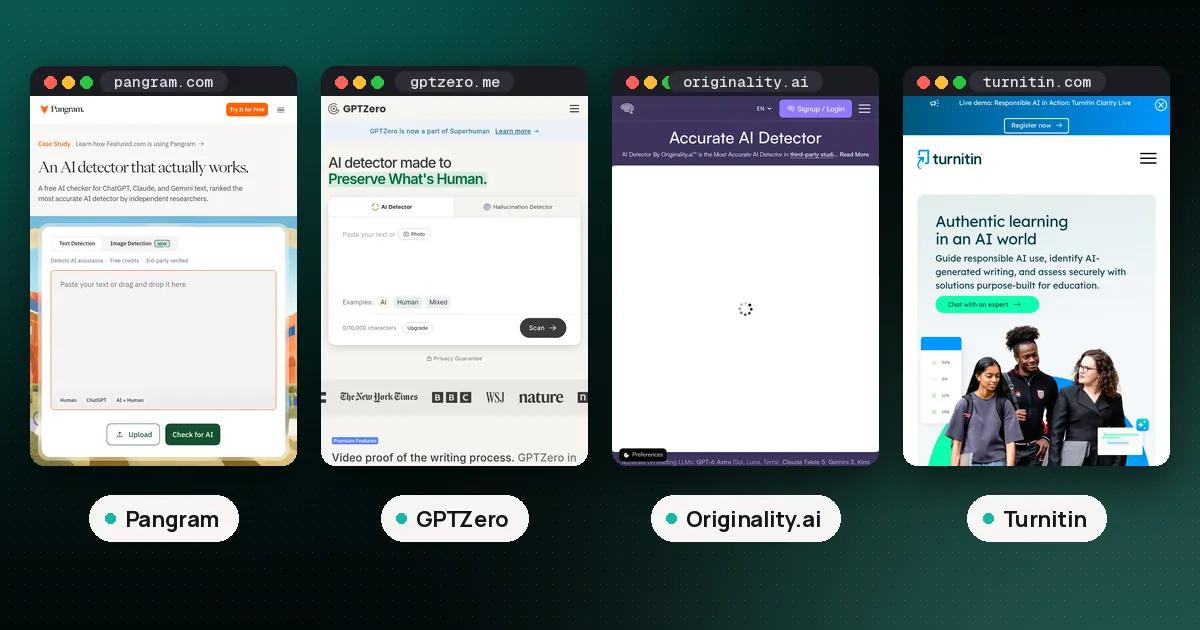
Pangram vs GPTZero is a choice between two standalone AI text detectors that anyone can try without an institutional license. Both sell freemium web tools aimed at teachers, publishers and teams; both ship sentence- or section level highlights; and both released major model updates in 2026 (Pangram 4 in July, GPTZero 4o as the default since September 20). Vendor blogs each claim to win head to head benches. Independent tests tell a more cautious story: both tools rarely accuse fully human writing, both can miss AI text that imitates a real author, and no public study has yet scored Pangram 4 against GPTZero 4o on the same corpus.
This guide compares access, pricing shape, how each score reads, what published research actually shows, and who each product fits. It links to the vendors' own docs and to independent work. For a broader look at detector reliability, see whether AI detectors are accurate. For Pangram against the campus default detector, see Pangram vs Turnitin. For the institutional alternative most students meet, see GPTZero vs Turnitin.
Pangram vs GPTZero at a glance
| Item | Pangram | GPTZero |
|---|---|---|
| Who can use it | Anyone: teachers, publishers, developers, individuals | Anyone: teachers, students, writers, teams, developers |
| Free tier | Up to 2,000 words per day, no card required (Pangram) | Free plan listed in GPTZero's FAQ at up to 10,000 words per month; unpaid scans also run on the homepage |
| Paid individual | Individual about 20 dollars a month; Professional about 65 dollars a month (pricing) | Essential / Premium / Professional tiers with word allowances from about 150,000 to 500,000 words a month (pricing) |
| Current model | Pangram 4.1 (released October 19, 2026; successor to Pangram 4 from July 29, 2026; model card back online October 25) | GPTZero 4o, default for all users since September 20, 2026 |
| Score style | Document verdict plus section windows (AI / AI assisted / human fractions) | Document probability plus sentence highlights; Advanced Scan adds named "AI Patterns" |
| Extra modalities | Built in AI image scans on every plan; 20 plus languages | Writing Replay for Google Docs; plagiarism on paid plans; several European languages |
| Ownership | Pangram Labs (independent) | Part of Superhuman (Grammarly's owner) as of September 30, 2026 |
In plain terms: if you want a low daily free allowance with strong multilingual and image options, start with Pangram. If you want a larger monthly free word budget, classroom integrations and writing process evidence, start with GPTZero. Accuracy claims from either vendor should be checked against independent tests before you treat a score as a verdict.
Who each tool is for
Pangram
Pangram is built for educators, publishers and trust and safety teams that need section level AI and AI assisted labels, not only a single percentage. The free plan covers up to 2,000 words per day with file upload, OCR, Chrome and Google Docs integrations, detection in over 20 languages, and a few image scans per day (Pangram homepage). Paid Individual and Professional plans raise monthly word and image limits; Professional includes monthly API credits. The developer API bills realtime checks at 0.05 dollars per 100 words, with a 20 percent discount for bulk jobs.
Pangram also sells LMS integrations (Canvas, Brightspace, Moodle, Google Classroom) on an educational institution plan. That puts it closer to Turnitin's deployment model for schools that want automatic checks, while still offering a consumer freemium path Turnitin does not.
GPTZero
GPTZero is the better known consumer brand in many English language classrooms. Its FAQ states a free plan of up to 10,000 words a month with the Chrome extension. Paid Essential, Premium and Professional plans raise word caps and add advanced scan features, batch uploads and API access; exact dollar prices change with currency and billing cycle, so check the GPTZero pricing page. Beyond the web app it offers a Google Docs addon, Classroom and Canvas integrations, Writing Replay for draft history, and a developer API.
On September 30, 2026, Superhuman confirmed that GPTZero is part of the company that also owns Grammarly (Superhuman announcement). That matters for roadmap (detection and authorship tools moving into Superhuman Go) more than for today's score.
Current models: Pangram 4.1 and GPTZero 4o
Pangram 4 and 4.1
Pangram announced Pangram 4 on July 29, 2026. The company says the model is roughly six times larger than Pangram 3, uses a mixture of experts layout, and improves mixed authorship and humanizer detection (Introducing Pangram 4). Vendor reported figures on its own benches include a false positive rate of 0.0041 percent (about one in 24,000 documents) and a false negative rate of 0.3396 percent, with Pangram 3 scheduled for deprecation on September 30, 2026. The Pangram 4 technical report (arXiv 2607.27183) expands those claims. Treat them as self reported until independent labs retest the shipping model.
Pangram released Pangram 4.1 on October 19, 2026 as the successor to Pangram 4. Its model card reports more stable predictions under small edits (unintended verdict flips across 29,103 paired edits fell from 1.08 percent to 0.15 percent) and adds a class probabilities output showing how sure the model is of each label (Pangram 4.1 model card). The card was offline on October 24 and loads again as of October 25, 2026, with the same figures. It also reports a lower English false positive rate on an in scope FineWeb set (0.0090 percent, 70 of 781,981 pages, against 0.0164 percent for Pangram 4 on the same set) and says the dashboard now shows less certainty for text under 150 words. Pangram's model card index still opens on Pangram 4, so use the direct link above.
GPTZero 4o
GPTZero made GPTZero 4o the default on September 20, 2026 (GPTZero 4o announcement). The post emphasizes mixed and paraphrased AI text, punctuation neutral scoring, Masked Detection that ignores headers, and Advanced Scan "AI Patterns" that name stylistic habits such as neat sets of three. Vendor reported highlights include one false positive across 10,402 PERSUADE student essays and over 99 percent recall on its own frontier model family bench. GPTZero also publishes its own head to head tables against Pangram versions; those are useful as vendor claims, not as neutral science.
What independent studies show
Neither company should be the sole referee of its own accuracy. Three public 2026 sources are useful for this pairing.
Springer peer reviewed study (June 2026). Researchers tested GPTZero, Turnitin, Pangram and Copyleaks on 160 academic papers with known authorship; AI text was generated in May 2025 (International Journal for Educational Integrity). All four cleared fully human papers. Pangram detected fully AI papers far better than GPTZero or Turnitin in that snapshot. GPTZero and Copyleaks performed poorly on mixed and "humanized" papers. The AI samples predate both Pangram 4 and GPTZero 4o.
Epoch AI / Samaritan style corpus (July 2026). A public reanalysis scored Pangram 3.3.2, GPTZero (2026-05-11-base) and Originality.ai on 495 pre ChatGPT human passages and 594 AI passages from Claude Opus 4.8, GPT-5.5 and Gemini 3.1 Pro, including style imitation prompts (Epoch AI data insight; code and tables on GitHub). Pangram and GPTZero both showed 0 percent false positives on the human set. On plainly prompted AI, miss rates were near zero. On style imitated AI, Pangram missed about 10 percent and GPTZero about 11 percent. Originality.ai had a higher false positive rate on human text and a higher miss rate on imitation.
University of Chicago Booth / BFI working paper. A larger policy oriented evaluation argued that Pangram was the only commercial detector in its set that met a stringent false positive policy cap (at or below 0.005) without collapsing detection of AI text (BFI working paper PDF). That paper used earlier model versions and different genres than the Springer study; it is evidence about false positive risk, not a live ranking of Pangram 4 versus GPTZero 4o.
The honest summary: on older model versions, both tools look strong at not accusing clean human prose, Pangram often led on hard AI cases in academic tests, and both still miss a meaningful share of style imitated AI. Until someone publishes a side by side of the October 2026 shipping models, "which is more accurate" is not a settled fact.
Features that change day to day use
Granularity. Pangram returns section windows with AI, AI assisted and human fractions, which helps when a paragraph was lightly edited or co-written. GPTZero highlights sentences and, in Advanced Scan, names rhetorical patterns. Teachers who need evidence for a conversation often prefer sentence highlights; editors who need to quarantine AI blocks often prefer section fractions.
Multilingual and image. Pangram advertises detection in over 20 languages and includes AI image scans on free and paid plans. GPTZero focuses on text, with multilingual options on paid tiers; for images and video, pair either tool with a dedicated detector from our deepfake detection guide.
Process evidence. GPTZero's Writing Replay shows how a Google Doc was drafted. Pangram does not lead with a draft playback product; its strength is content classification plus LMS hooks. If a false positive would be costly, process evidence beats either score alone.
API and automation. Both offer developer APIs. Pangram publishes word based prepaid credits at 0.05 dollars per 100 words. GPTZero publishes client libraries in many languages and rates that depend on plan. Publishers comparing detectors for a pipeline should also trial Originality.ai, which targets content teams more directly.
Pros and cons
Pangram pros: strong independent results on older versions; transparent technical report for Pangram 4; daily free allowance; multilingual and image detection; clear section level AI assisted labels; LMS path for schools. Cons: free daily cap is smaller than GPTZero's commonly cited monthly free allowance; newest accuracy numbers are still largely vendor reported; less classroom brand recognition in some regions.
GPTZero pros: large existing classroom footprint; higher free monthly word budget per the FAQ; Writing Replay and AI Patterns for explainability; Superhuman / Grammarly ecosystem; mature Chrome and Docs tooling. Cons: earlier independent tests found weaker results on mixed and humanized academic text; vendor benches against Pangram should not be treated as neutral; free tier limits are easier to find in the FAQ than on the marketing pricing table.
Which should you use?
- Individual teachers without an LMS license: try both free tiers on the same five student samples. Prefer the tool whose highlights match what you see when you read the draft.
- Schools that need LMS automation: evaluate Pangram's institution plan alongside Turnitin; GPTZero's Classroom integrations remain a lighter alternative.
- Publishers and SEO teams: Pangram's section labels and API pricing are often easier to operationalize; still A/B test against Originality.ai on your own corpus. For a no card trial path, see how to use Originality.ai for free.
- Students checking their own drafts: either free tier works as a mirror, not a verdict. Keep version history. A flag is a reason to revise or talk with an instructor, not proof of cheating.
- Disputed academic cases: run a second detector and collect process evidence. Our accuracy guide walks through what to do if you are flagged.
AI text detection is only one integrity signal. For watermark checks on Google and partner content, see SynthID Detector. Writers publishing on Substack can follow how to use Pangram on Substack. For whether model answers invent facts, see LLM hallucination detection.
FAQ
Is Pangram better than GPTZero?
Not in a single absolute sense. On 2026 independent tests of earlier versions, Pangram often led on hard AI cases and matched GPTZero at near zero false positives on clean human text. GPTZero 4o and Pangram 4.1 have not been scored together by a public third party yet, so vendor win claims on either side are incomplete.
Does Pangram detect ChatGPT and Claude?
Pangram markets detection of text from major chat models including ChatGPT, Claude, Gemini and Llama families, and Pangram 4's launch post claims low miss rates across frontier families on its own benches. Always recheck on samples from the models your writers actually use.
Is GPTZero free?
Yes. GPTZero's FAQ describes a free plan of up to 10,000 words per month, and the homepage allows unpaid scans with a per scan character limit. Paid plans raise monthly word caps and add advanced features; see the live pricing page for current dollar amounts.
Is Pangram free?
Yes. Pangram's free plan covers up to 2,000 words per day without a payment method, plus limited daily image scans, multilingual detection and browser integrations. Individual and Professional plans raise monthly limits.
Can I use Pangram or GPTZero instead of Turnitin?
For personal checks, yes. For graded coursework, usually no: institutions that license Turnitin control who sees the AI indicator. Some schools add Pangram or GPTZero as a second signal; that is a policy choice, not a student workaround.
Should I trust a single AI detection score?
No. Scores can disagree across tools, drift when models update, and miss style imitated AI. Combine two detectors when stakes are high, read the highlighted spans yourself, and prefer draft history over a percentage when someone disputes a flag.