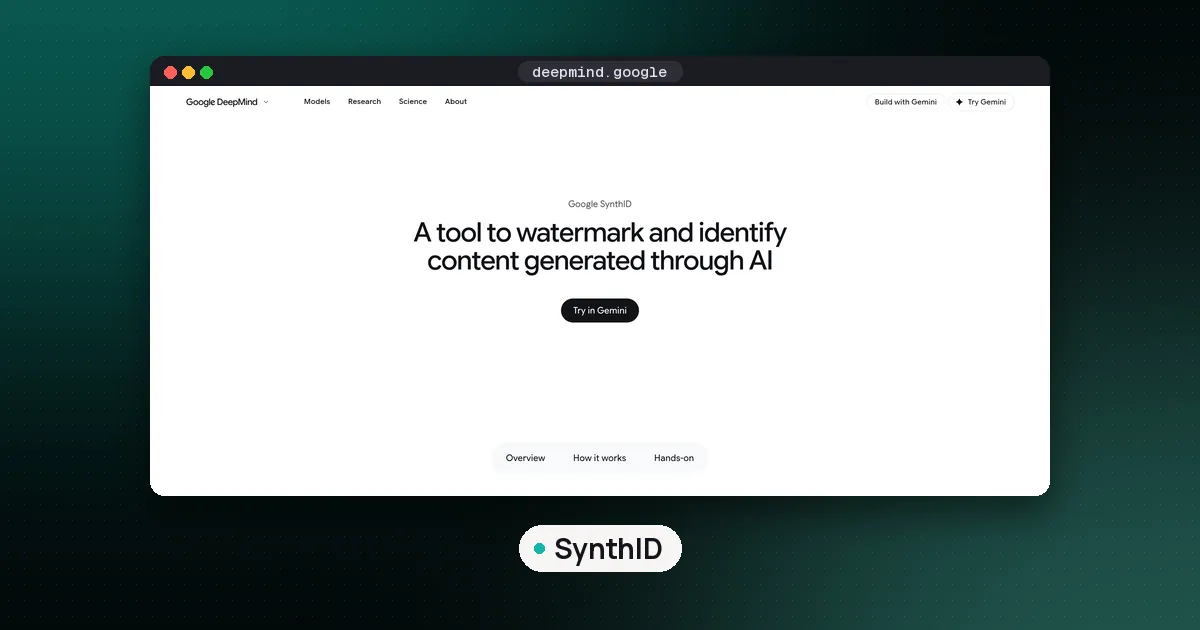
SynthID Detector is Google DeepMind's web portal for checking whether an image, video or audio file carries a SynthID watermark, the invisible signal Google and its partners embed in AI generated media. On October 7, 2026, Google opened it to everyone, globally, in English. It can confirm content made with AI from Google, OpenAI, NVIDIA and Kakao, with Apple announced as coming soon. It cannot tell you whether a file from any other AI tool is fake, and it does not check text.
This guide explains what changed, how the watermark works, how to run a check step by step, how to read the result, and which other free checkers to combine it with. Every fact below links to an official source.
What changed on October 7, 2026
Google first announced SynthID Detector in May 2025 as a verification portal for early testers, with journalists, media professionals and researchers invited to join a waitlist (Google, May 2025). On October 7, 2026, Google said it was expanding access to everyone, with the tool available globally in English (Google, October 2026).
The same announcement gave three numbers worth knowing:
- Google has watermarked over 180 billion images and videos and 240,000 years of audio since SynthID launched in 2023.
- The new detector recognizes content from Google and its partners OpenAI, NVIDIA and Kakao, and "soon" Apple.
- Google's built in verification features in Search, the Gemini app and Chrome now handle over 1 million requests a day.
The launch drew immediate attention. A Hacker News post about it reached over 100 points with nearly 100 comments on launch day (discussion), with much of the debate focused on the sign in requirement and how easily watermarks can be stripped.
How SynthID watermarking works
SynthID adds a watermark at the moment content is generated, rather than trying to guess afterwards whether something looks synthetic (Google DeepMind).
- Images and video: the signal is woven into the pixels. Google says it does not change visible quality and is designed to survive cropping, filters, frame rate changes and lossy compression.
- Audio: the signal sits in the frequency components of the sound. Google says it is inaudible and holds up to added noise, MP3 compression and speed changes.
- Text: for text from the Gemini app and web experience, SynthID nudges the probabilities the model uses to pick each next word, leaving a statistical pattern a detector can test for.
Google's research paper on the image version describes it as post hoc and model independent: the watermark is applied on top of finished output by an encoder and read back by a decoder, so it can be used with any generator, including partners' models (SynthID-Image paper). That design is why one detector can now recognize content from several companies.
How to use SynthID Detector, step by step
- Get the best copy you can. The portal asks for the highest quality file possible. An original download beats a reshared, recompressed copy, and a full image beats a screenshot.
- Open the portal at synthid.com. At launch, early users on Hacker News reported having to sign in (with a Google, Apple or ChatGPT account) and accept terms before uploading.
- Choose the media type and upload. The detector supports images, video and audio.
- Read the result. For images it reports whether a watermark is present. For video and audio it identifies the segments where the watermark was detected, which helps when only part of a clip was generated.
- Record what you found and combine it with other evidence before drawing a conclusion.
What the results mean
The portal's own FAQ is clear about how to interpret the two outcomes (SynthID Detector FAQ):
- Watermark detected: the file was likely generated or edited by a SynthID enabled model. Google notes that in very rare cases the detector can falsely trigger on content without a watermark.
- Watermark not detected: no confident signal was found. That does not rule out AI. The file may come from a model without SynthID, may predate a partner's adoption, or may have been edited heavily enough to degrade the signal.
The second point matters most. A "not detected" result rules out only the participating companies, and only for files that kept their watermark. It is never proof that an image or recording is real.
What SynthID Detector cannot do
It is not a general AI detector. Google says so directly on the portal: it only detects media from companies that have adopted SynthID. Images from tools outside that group will simply come back "not detected".
It does not check text. Even though Gemini text is watermarked, the portal currently lists only images, video and audio. Google open sourced its SynthID text watermarking so developers can add it to their own models (noted in the May 2025 announcement), but there is no public text check in the detector. For essays and other writing, see our guide on whether AI detectors are accurate and our comparison of GPTZero vs Turnitin. For ownership marks embedded in model behavior (not content watermarks), see AI model fingerprinting. OpenAI has its own text scheme, textGrain; see does ChatGPT have a watermark.
It can be beaten. Google states that the watermark is not infallible: someone who tries many transformations may find one that defeats detection. The portal calls SynthID one layer in a broader provenance approach, not a standalone guarantee.
It is a single file web tool. Google's announcement describes a portal for people to check files one at a time. Back in 2025 Google named GetReal Security as a partner able to detect SynthID, so organizations that need checks at scale should look at partner products or at the vendor APIs below.
SynthID Detector vs other free checkers
| Checker | What it reads | Recognizes | Notes |
|---|---|---|---|
| SynthID Detector | SynthID watermark | Google, OpenAI, NVIDIA, Kakao | Images, video, audio |
| Gemini app | SynthID plus Content Credentials | Google AI only (SynthID) | About 10 checks per media type per day |
| OpenAI verification tool | SynthID plus OpenAI C2PA data | OpenAI only | Images and audio; free API with limits |
| Content Credentials Verify | C2PA provenance | Any signing app or camera | Nothing to read if metadata was stripped |
| Hive classifier | Statistical traces | Any generator, as a probability | Can miss new generators |
In plain terms, the new portal is the broadest watermark checker, because it covers several companies at once. The Gemini app (Google also offers checks in Search and Chrome) remains useful because it also reads Content Credentials, but Google's help page says Gemini currently recognizes SynthID only in content made by Google AI tools, with a usage quota of roughly ten image, ten video and ten audio checks in any rolling 24 hour window (Gemini help).
The OpenAI verification tool checks images and audio for OpenAI's own signals. OpenAI says images from ChatGPT, Codex and its API carry both Content Credentials and SynthID, and audio from ChatGPT and the API carries SynthID. It also offers a free Content Provenance API, subject to usage limits, and says uploads are not stored unless legally required and are not used for training (OpenAI help). Since October 5, 2026, OpenAI also watermarks ChatGPT text in the EU with its own method, called textGrain, rather than SynthID, and access to that text detector is limited to approved researchers (OpenAI).
Content Credentials Verify reads signed C2PA history from any participating camera, editor or generator, and Hive gives a classifier opinion on files that carry no label at all (see how Hive deepfake detection works). Our deepfake detection guide covers how to weigh these three kinds of signal together.
How reliable is SynthID?
Google's paper reports strong results for an external variant of the image watermark, called SynthID-O, in its own tests: with the detector tuned to a 0.1 percent false positive rate, it found watermarks in 99.72 percent of images under the worst case settings of 30 common transformations, ahead of the other published watermarking methods it compared (SynthID-Image paper). Treat that as a vendor benchmark, not an independent audit. The same paper is frank that perfect security is impossible, and it treats watermark removal, forgery and model extraction as threats to defend against rather than solved problems.
In practice, the failure you are most likely to meet is the boring one: a file that was screenshotted, cropped hard, reencoded several times or run through another AI tool. OpenAI's documentation says heavy cropping, compression or extensive changes can make watermarks undetectable, while light edits and screenshots are designed to survive. When a result matters, get the earliest copy you can find.
Who should use it
- Everyday users checking a viral image or clip: run SynthID Detector first, then Content Credentials Verify, and look for the original source.
- Journalists and fact checkers: combine the portal with provenance, a classifier and reverse image search, and keep notes on each result.
- Teachers and editors: use it for images, audio and video only. It will not help with essays.
- Trust and safety teams: treat it as a spot check tool, and evaluate partner or vendor APIs on a sample of your own content before relying on them, using the approach in our guide on how to evaluate LLM applications.
FAQ
Is SynthID Detector free?
Google's October 7, 2026 announcement opens the portal to everyone and mentions no price. At launch, users reported needing to sign in and accept terms before uploading a file.
Can SynthID Detector check text?
Not at the moment. The portal supports images, video and audio. Gemini text carries a SynthID watermark, but there is no public text check in the detector, so it cannot tell you whether an essay was written with AI.
Can SynthID Detector detect ChatGPT images?
Yes, for files that kept their watermark. OpenAI is one of Google's SynthID partners and says images from ChatGPT, Codex and its API include SynthID. OpenAI's own verification tool is a second option that also reads its Content Credentials.
Does "not detected" mean an image is real?
No. It only means no SynthID watermark was found. The file could come from an AI tool that does not use SynthID, or a watermark could have been degraded by heavy editing or compression.
Can a SynthID watermark be removed?
Google says it holds up against common changes such as filters, color shifts and lossy compression, but not infallible: someone who tries many transformations may find one that avoids detection. That is why a missing watermark proves little.