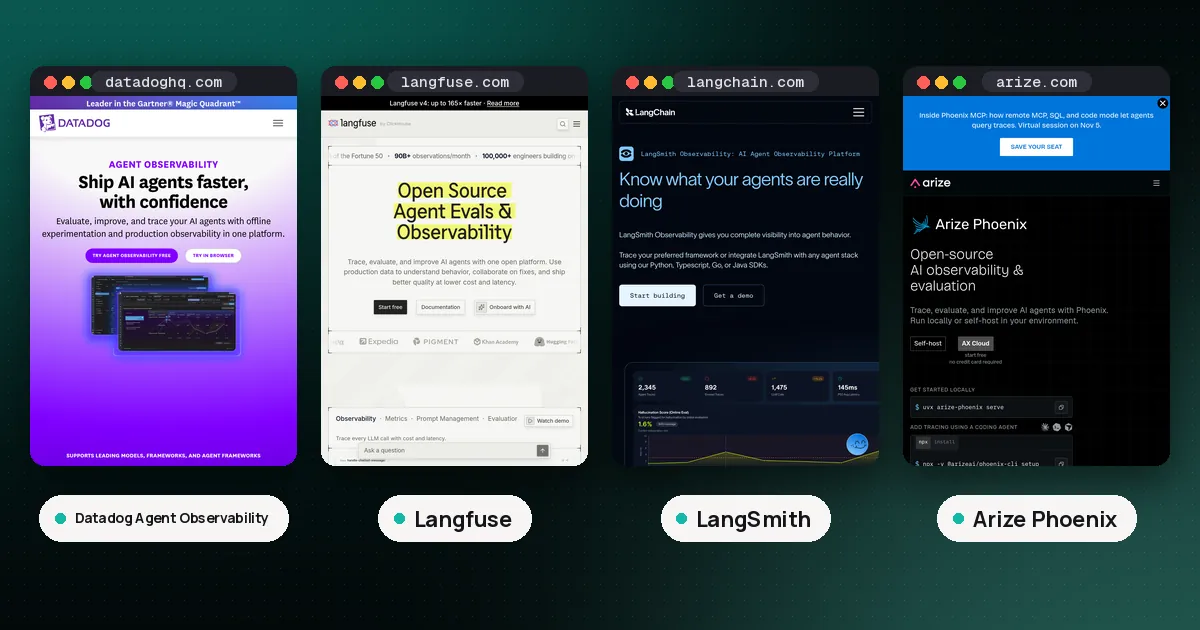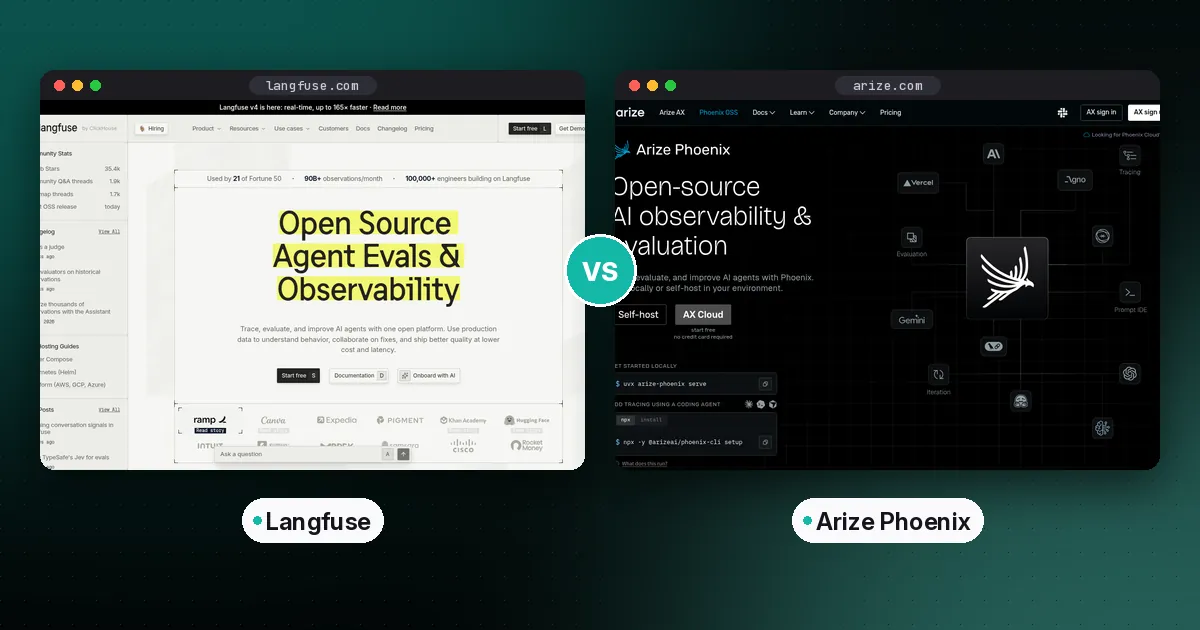
In the Langfuse vs Arize Phoenix choice, pick Phoenix if you want the fastest free self host, a single container that runs on SQLite or PostgreSQL, and a notebook friendly tool for experiments and evals. Pick Langfuse if you want an MIT licensed core, a production grade multiuser platform with strong prompt management, and a managed cloud with simple plans when you outgrow self hosting. Both are built on OpenTelemetry, both trace, evaluate and version prompts, and both changed owners in 2026. Teams already on Datadog should also compare Datadog LLM Observability vs Langfuse.
This comparison covers licensing, self hosting effort, features, managed pricing and ownership as of October 2026, and ends with a decision guide.
Langfuse vs Arize Phoenix at a glance
| Item | Langfuse | Arize Phoenix |
|---|---|---|
| License | MIT core; enterprise directories need a license key | Elastic License 2.0, source available; free to self host with no feature gates |
| Self host stack | PostgreSQL, ClickHouse, Redis or Valkey, blob storage | One container; SQLite by default, PostgreSQL 14 or newer for production |
| Quick start | Docker Compose from the repository | pip install arize-phoenix, then phoenix serve |
| Instrumentation | OpenTelemetry based SDKs and integrations | OpenTelemetry with Arize's OpenInference conventions |
| Managed option | Langfuse Cloud: free Hobby tier, paid plans from 29 dollars a month | Arize AX: free tier, Pro at 50 dollars a month |
| Owner in October 2026 | ClickHouse, since January 2026 | Arize, part of Dynatrace since October 2026 |
In short: Phoenix is lighter to run and has no paid feature tiers, while Langfuse is built for multiuser production from the start and has the more permissive license. The managed upgrade paths differ too: Langfuse Cloud is the same product hosted, whereas Arize AX is a separate commercial platform that uses the same instrumentation.
Is Arize Phoenix open source?
Phoenix's source code is public and free to self host, and Arize describes it as fully open source with no feature gates. Strictly, though, it is released under the Elastic License 2.0, which is source available rather than an OSI approved open source license; the main restriction is on offering Phoenix to others as a managed service (Phoenix license page). For internal use, that rarely matters.
Langfuse's core is MIT licensed, one of the most permissive licenses, while a small set of enterprise features live in separate directories and need a license key (Langfuse self hosting). If your legal team insists on OSI approved licenses, Langfuse is the safer pick.
Self hosting compared
Phoenix is a single containerized application with a web UI, a trace collector and a SQL database. By default it stores data in SQLite in a local directory, which suits local development and single users; for production and multiple users, Arize recommends PostgreSQL version 14 or newer (Phoenix architecture). You can run it with two commands, pip install arize-phoenix followed by phoenix serve, or deploy the official Docker image or Helm chart.
Langfuse runs the same architecture as Langfuse Cloud: web and worker containers backed by PostgreSQL, ClickHouse, Redis or Valkey, and S3 compatible blob storage. A Docker Compose setup gets you running locally in a few minutes, but Langfuse itself says that setup lacks high availability, scaling and backups, and recommends Kubernetes for production (Docker Compose guide). Self hosting the MIT core costs nothing in license fees, even in a commercial product, as our Langfuse commercial use guide explains.
So Phoenix wins on day one simplicity; Langfuse's heavier stack is the price of an analytics database designed for high trace volumes.
Features compared
Both cover the core LLM observability loop: tracing, evaluation, datasets, experiments and prompt management. Both also trace multistep agents; our AI agent observability guide covers what to record for tool loops.
- Tracing: both ingest OpenTelemetry. Phoenix uses Arize's OpenInference instrumentation packages and includes a setup command that detects your framework and wires up tracing. Langfuse has native Python and JavaScript SDKs plus many framework integrations, and also accepts data from instrumentation libraries such as OpenLLMetry.
- Evaluation: both run LLM-as-a-judge and code evaluators on traces and datasets. Phoenix grew out of notebook based evals and remains strong for experimentation. Langfuse adds human annotation queues and score analytics aimed at teams.
- Prompt management: both version prompts and offer a playground. Langfuse's prompt management, with labels for deploying versions to production, is one of its most cited strengths.
- Extras: Phoenix now includes an AI assistant for debugging traces and a remote MCP endpoint for coding tools. Langfuse offers sessions, user tracking, cost dashboards and cloud regions in the US, EU and Japan.
Pricing and managed options
Self hosting either tool costs nothing beyond infrastructure. The managed options differ.
Langfuse Cloud has a free Hobby plan with 50,000 units a month, where a unit is a trace, observation or score, plus 30 days of data and two users. Core is 29 dollars a month with 100,000 units and unlimited users, and Pro is 199 dollars a month with three years of data access (Langfuse pricing).
Arize's managed product is Arize AX rather than hosted Phoenix. AX Free includes 25,000 spans a month, 1 gigabyte of ingestion and 15 days of retention; AX Pro costs 50 dollars a month with 50,000 spans, 10 gigabytes and 30 days of retention, with enterprise plans above that (Arize pricing). The same OpenTelemetry and OpenInference instrumentation works for Phoenix and AX, so moving between them does not require reinstrumenting.
Ownership after the 2026 acquisitions
ClickHouse acquired Langfuse in January 2026; the Langfuse team said there were no planned licensing changes and self hosting remains first class (announcement). Dynatrace completed its acquisition of Arize on October 1, 2026, and says Arize will continue to support Arize Phoenix and AX (Dynatrace). Both products are now backed by large infrastructure companies, which brings resources but also roadmap risk. Instrumenting with OpenTelemetry is your insurance either way.
Which should you choose?
- Solo developer or data scientist experimenting in notebooks: Phoenix. Two commands and you are tracing.
- Team running production traffic and wanting one shared platform: Langfuse, self hosted on Kubernetes or on Langfuse Cloud.
- Strict license requirements: Langfuse's MIT core.
- Prompt management as a core workflow: Langfuse.
- Already a Dynatrace customer: Phoenix and Arize AX will likely integrate most closely with your existing stack.
- Unsure: instrument with OpenTelemetry and send traces to both for a week; compare on your own data.
Pros and cons
Langfuse pros: MIT core, production ready multiuser design, strong prompt management, managed cloud that is the same product. Cons: heavier self host stack, enterprise access controls cost extra.
Phoenix pros: easiest self host, no feature gates, strong experiments and evals, smooth path to Arize AX. Cons: Elastic License rather than OSI open source, SQLite default needs swapping for PostgreSQL in production, managed option is a different product.
Alternatives
If neither fits, LangSmith is the managed choice for LangChain heavy teams, compared in our Langfuse vs LangSmith guide, and Opik from Comet is an Apache 2.0 alternative from an independent vendor. See all the options in our roundup of the best LLM observability tools, and use the LLM hallucination detection guide and the LLM-as-a-judge guide to decide which evaluators to run on your traces.
FAQ
Is Arize Phoenix free?
Yes, Phoenix is free to self host with no usage limits or feature gates. Arize's managed platform, Arize AX, has a free tier and paid plans starting at 50 dollars a month.
Is Arize Phoenix open source?
Its code is public and free to self host, but it is licensed under the Elastic License 2.0, which is source available rather than OSI approved open source. The main restriction is offering Phoenix as a hosted service to others.
Is Langfuse better than Phoenix?
Langfuse is better for multiuser production deployments, prompt management and permissive licensing. Phoenix is better for quick local setup, experimentation and teams who want a free tool with no paid tiers.
What database does Arize Phoenix use?
Phoenix uses SQLite by default for local and single user setups, and supports PostgreSQL version 14 or newer for production and multiuser deployments.
Can I switch from Phoenix to Langfuse later?
Yes, if you instrument with OpenTelemetry. Both accept OpenTelemetry traces, so you can point your exporter at the other backend; datasets and prompts need exporting and reimporting through each tool's API.